Originally written in German. Translated to English by AI — please excuse any awkward phrasing.
And last but not least — the marathon, naturally only after you’ve properly warmed up 😉
Running has become my absolute favorite discipline. On one hand because it’s probably the most honest of the three sports — on the other because I’m just pretty good at it now and it gives me a huge amount of joy.
After setting the bar pretty high last year with a marathon of 3:09:20h, I’ll need to work a bit harder this year to top it …
That challenge I will accept and conquer — and here’s why. As a rule of thumb for the pace you can run in an Ironman marathon, your long run pace is the generally accepted benchmark. Good runners — which I’d count myself — can go about 10 seconds per kilometer faster. Last year I did my long runs mostly at 4:40–4:50 min/km pace, and ran the marathon at about 4:30 min/km.
This year it’s a bit different — meaning faster. My fastest long run was 4:28 min/km (including a lot of climbing); the slowest was 4:35 min/km. Take 10 seconds off that and you land at 4:20 min/km. That’s also roughly the pace at which I’ve been starting all my brick runs, and still feeling like I’m going slow. A very good sign.
Further confirmation came from race results and training performances — I’ve made another big jump in running.
Oh, and a pace of 4:20 min/km works out to a marathon time of just about 3 hours. OK, I’d also take a 2 as the first digit. Might as well go for it …
There won’t be any grand tactics during the marathon — I’ll run it evenly as always (about 45 minutes per lap for each of the 4 laps) and hope not to pay for the extra risk in the back half.
These are the shoes that are supposed to make it happen — a Saucony Grid Type A5:
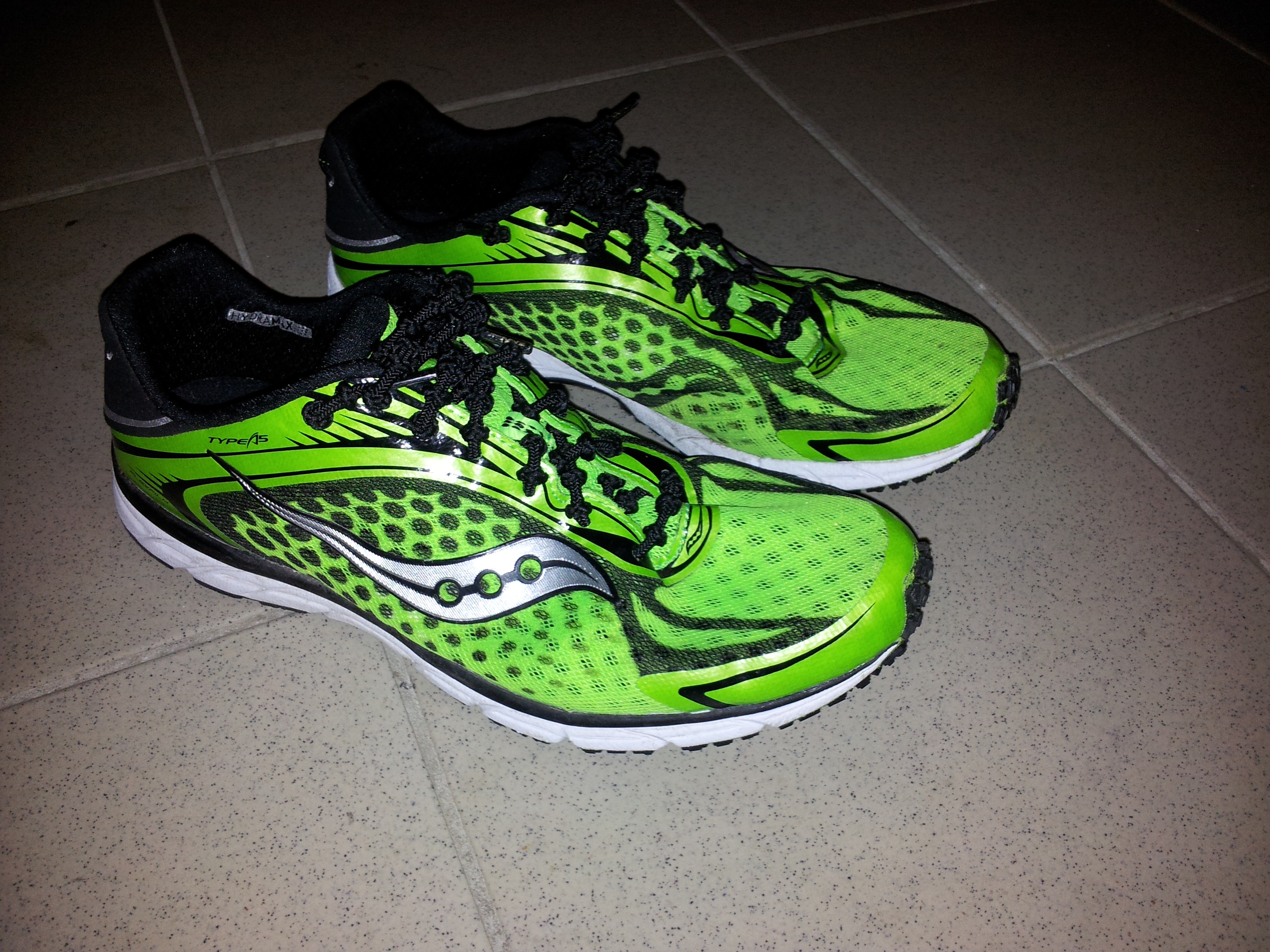
A genuinely awesome shoe — flat and fast, minimal cushioning, light weight — a proper racing flat! I’ve raced all my races this year in this shoe, all with new running PRs. A good omen …